




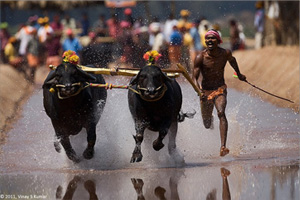
Kambala or Kamblā (Tulu: ಕಂಬಳ) is a traditional water buffalo race in muddy waters, held from December till March. It is the native sport of Tulu Nadu (DK or South Canara district, Karnataka, India) region of South India. Kambala is traditionally a simple sport. The 'track' used for Kambala is a paddy field filled with slush. The contest generally takes place between two pairs of buffaloes, controlled by a whip-lashing farmer. In olden days, the winning pair of buffaloes were rewarded with coconuts and a bunch of plantains. But, Kambala today has become an organised,professional sports. People place massive amounts of bets on the winning buffaloes and one can witness more than 20,000 spectators in a well organised Kambala, egging and cheering the buffaloes to complete the race. As of now, more than 45 races are held annually in Coastal Karnataka. Nearly 18 kambalas are held under the banner of Kambala Samithi and the rest are held under the auspices of temples, political patronage and aristocratic Bunt households. Kambala still remains a hugely popular sport in Coastal Karnataka. Source: Wikipedia
Photography by: Vinay S Kumar
http://piavinay.blogspot.com/
http://www.Facebook.com/vinayskumar1
Photography by: Vinay S Kumar
http://piavinay.blogspot.com/
http://www.Facebook.com/vinayskumar1

Of course, one can’t deny that since cinema caters to a largely rural target audience, the subject matter tends to border on regional festivals or culture which undoubtedly brings in Bihu. “Producers and directors are afraid to experiment, fearing it might offend their market. But people are ready for a makeover. So we should take advantage of that. Besides, there are very few cinema halls in these places. We need to have more mini-cinemas in these places. Also, regional cinema has a lower budget compared to say Bollywood. So that again hampers the intention of making good films at times,” says Nishita. There’s yet another angle to the predictability of Assamese films. Nishita is often seen playing the quintessential Assamese sweetheart that every man loves to introduce his mom to. While she perfectly suits the bill, does she fear getting stereotyped? “Generally I suit into bubbly, innocent roles. But of course, you want to change the image sometimes. Say, if I get an opportunity to do a negative role, I would love to do it.”

By the way, Nishita is also an M Ed and has always been interested in teaching and education. She didn’t however become a teacher, but she managed to put together her idea of a kindergarten to train little kids. “I have recently opened a school in partnership with Mrs. Preeti Saikia, wife of Late Bhabendranath Saikia (novelist, short story writer and film director) called Aarohan Kids. I am heading the school and it’s just been two weeks!” While she is nestling so many babies in her kitty, we are curious what her next move would be. “I want to open a production house, though maybe not immediately; it’ll take me a few years, but yeah, that is in mind.” Her idea of the films that should be made and the changing persona of the audience should make her produce the kind of films and acting, we have been waiting for. As for her, we wish her luck for all her dreams.
Of course, one can’t deny that since cinema caters to a largely rural target audience, the subject matter tends to border on regional festivals or culture which undoubtedly brings in Bihu. “Producers and directors are afraid to experiment, fearing it might offend their market. But people are ready for a makeover. So we should take advantage of that. Besides, there are very few cinema halls in these places. We need to have more mini-cinemas in these places. Also, regional cinema has a lower budget compared to say Bollywood. So that again hampers the intention of making good films at times,” says Nishita. There’s yet another angle to the predictability of Assamese films. Nishita is often seen playing the quintessential Assamese sweetheart that every man loves to introduce his mom to. While she perfectly suits the bill, does she fear getting stereotyped? “Generally I suit into bubbly, innocent roles. But of course, you want to change the image sometimes. Say, if I get an opportunity to do a negative role, I would love to do it.”
Of course, one can’t deny that since cinema caters to a largely rural target audience, the subject matter tends to border on regional festivals or culture which undoubtedly brings in Bihu. “Producers and directors are afraid to experiment, fearing it might offend their market. But people are ready for a makeover. So we should take advantage of that. Besides, there are very few cinema halls in these places. We need to have more mini-cinemas in these places. Also, regional cinema has a lower budget compared to say Bollywood. So that again hampers the intention of making good films at times,” says Nishita. There’s yet another angle to the predictability of Assamese films. Nishita is often seen playing the quintessential Assamese sweetheart that every man loves to introduce his mom to. While she perfectly suits the bill, does she fear getting stereotyped? “Generally I suit into bubbly, innocent roles. But of course, you want to change the image sometimes. Say, if I get an opportunity to do a negative role, I would love to do it.”

In recent years, mobile theatres in Assam have caught up an enviable pace and popularity. It is not only a lucrative business but also a hugely profitable career for many film actors, who haven’t seen much sunshine in the film scene. But not all actors have changed their loyalties yet. Nishita is one of them, though she wouldn’t like to put it that way. “I have been approached by several theatre companies but for now, I have no plans of doing that. There’s a lot of hard work in it and lot of money, but money isn’t everything after all. Mobile theatres work on a contract of eight to nine months. You have to do shows every day, and travel after every three days for more shows. For some, this is even the bread and butter. So they don’t have another choice.”

I'll always need my mum no matter what age I
am...... My Mum has made me laugh... wiped my
tears... hugged me tight... watched me succeed...
saw me fall... cheered me on... kept me going
strong... and drove me a little crazy at times! But
my Mum is a promise from God that I will have a
friend forever! Love you Mom A call from renowned director, Bani Das brought about a turning point in her life, when she was around 18. Das was planning a new film called Mon. Nishita was pretty young for a meeting about the script and Das had to discuss his idea with her parents instead. After her parents consented for her role, Nishita got her first break in a film as an adult. Between ensuing exams and student responsibilities, Nishita managed to do the film. While she has been able to make her own space in the industry today, one question does spring to the mind for certain: What would it have been, if it were not for her mother? Did the fact that her mother was an actor help her in getting any leeway into acting? “Not exactly, but yes, she has helped and encouraged me a lot. My mother was very particular that I should complete my studies and she also wanted me to be choosy with what kind of characters I play. Whatever I have done so far, I am proud of that.”
She is the girl-next-door of Assamese cinema. A smile on her face coupled with equally congenial behaviour is what she carries as a brand statement. But while she is one of the most sought-after actors of the Assamese film industry, the daughter of veteran actor Moloya Goswami and lately the leading heroine of Ramdhenu, she speaks to you as if she knows you since childhood. Nishita Goswami is charming to day the least, with her head firmly on her shoulders and her dreams soaring high in the sky.
Nishita was like just another little girl, who was expected to concentrate on her studies and be mama’s good girl. But while she was schooling like any other kid, she went a step ahead of others when she entered the film industry at the tender age of six and marked a niche for herself in a professional field. “I did a film called Raati Phula Phul with my mother. I didn’t quite realise what was going on, since I was pretty young at that time.” By the time she was around eight, Nishita was already doing stage plays. From one-act plays in Natasurjya Phani Sarma to children’s plays, she had got the taste of theatre at an age when children learn just about enough to differentiate between theatre and films in spelling.
am...... My Mum has made me laugh... wiped my
tears... hugged me tight... watched me succeed...
saw me fall... cheered me on... kept me going
strong... and drove me a little crazy at times! But
my Mum is a promise from God that I will have a
friend forever! Love you Mom A call from renowned director, Bani Das brought about a turning point in her life, when she was around 18. Das was planning a new film called Mon. Nishita was pretty young for a meeting about the script and Das had to discuss his idea with her parents instead. After her parents consented for her role, Nishita got her first break in a film as an adult. Between ensuing exams and student responsibilities, Nishita managed to do the film. While she has been able to make her own space in the industry today, one question does spring to the mind for certain: What would it have been, if it were not for her mother? Did the fact that her mother was an actor help her in getting any leeway into acting? “Not exactly, but yes, she has helped and encouraged me a lot. My mother was very particular that I should complete my studies and she also wanted me to be choosy with what kind of characters I play. Whatever I have done so far, I am proud of that.”
She is the girl-next-door of Assamese cinema. A smile on her face coupled with equally congenial behaviour is what she carries as a brand statement. But while she is one of the most sought-after actors of the Assamese film industry, the daughter of veteran actor Moloya Goswami and lately the leading heroine of Ramdhenu, she speaks to you as if she knows you since childhood. Nishita Goswami is charming to day the least, with her head firmly on her shoulders and her dreams soaring high in the sky.
Nishita was like just another little girl, who was expected to concentrate on her studies and be mama’s good girl. But while she was schooling like any other kid, she went a step ahead of others when she entered the film industry at the tender age of six and marked a niche for herself in a professional field. “I did a film called Raati Phula Phul with my mother. I didn’t quite realise what was going on, since I was pretty young at that time.” By the time she was around eight, Nishita was already doing stage plays. From one-act plays in Natasurjya Phani Sarma to children’s plays, she had got the taste of theatre at an age when children learn just about enough to differentiate between theatre and films in spelling.